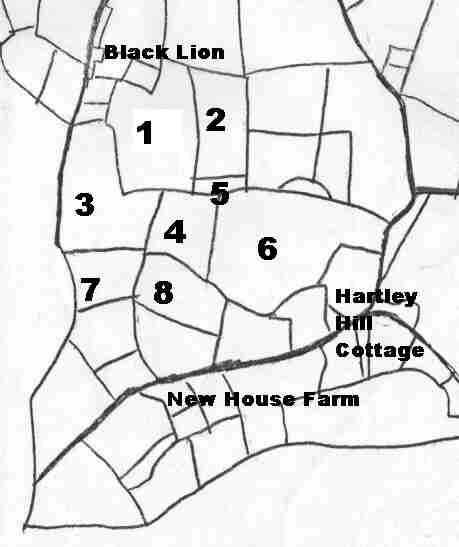
Map of Northfield in 1844.
Northfield was not one field then, but has beeen formed from no less than eight fields - listed below
1 Fourteen Acre
Field (arable)
2 Shaw Field (arable)
3 Lower Pitt Field (arable)
4 Eight Acre Field (arable)
5 Shaw (wood)
6 East Haws (arable)
7 Upper Pitt Field (arable)
8 Lower Barn Field (arable)
Introduction
It is safe to say that Northfield has been one of the most controversial issues locally for the past 20 years or so. In such cases facts are often at a premium, so we have attempted here to present a history of the field that we hope is readable and informative.
What's in a Name?
The name Northfield is very recent, and is the New Ash Green name for the land - after all it is well to the south of Hartley! More correctly it is known as New House Field or Black Lion Field. And part of the land used to be called Pitfield, no doubt something to do with the ancient dene holes (chalk workings) which have been found here.
Before New Ash Green
We first meet the land that became Northfield in 1604, when Richard Overy was the owner of Woodins, Forge Cottage "and threescore acres of ground more or less, lying together in several parcels to a green against the said messuage called the Smyth's Forge towards the east, to the highway leading from Ash to Dartford towards the west, to the lands of William Sedley esquire towards the north, and to the lands of Thomas Launce and of John Walter gent. towards the south."
He and Petronella, his wife, sold this land to Thomas Burrowe of New House Farm in 1622, so creating the farm which lasted up to the 1960s. The farm was mainly arable with wheat as the main crop. James Burrow (d1729) is commemorated in Hartley Church.
Eventually the estate descended in 1790 to John and Sarah Tasker of the Dartford brewing family. They owned it until the 1840s. Later George Day of North Ash Farm was the owner. He put the farms up for sale in 1926, the sale particulars stated "special attention is drawn to the rapid building developments adjoining this lot, and to the fact that field No. 112 (Northfield, Farm Holt, Caling Croft etc) is now practically the only building site left, and with its frontage of 1,500 feet this portion could readily be sold off without detriment to the farm." In 1941 New House belonged to Messrs Ansell and Hunt of Romford.
When the War Agriculture Executive visited in 1941, they were impressed with the farmer, Marwood Fulford, giving him an "A" grade. It was mainly arable, growing a variety of grains and fodder crops as well as a few pigs and cows. To help the war effort, some grass fields were ploughed up including the site of the future Farm Holt. The farmland was good quality, for before the war more demanding crops such as cabbages and strawberries were grown on Northfield.
The End of New House Farm
Ansell and Hunt were unsuccessful in their application for housing here in 1960, and quickly sold the land to Span Developments. They renewed the planning application in 1963 for a village of 5-6,000 (the numbers became important in the 1980s). This too was refused by the council and planning inspector, but this was overturned on appeal by the then Secretary of State for the Environment, Richard Crossman. It is clear from a letter he wrote to a protester that the decision was a political one. He believed that Kent County Council were stalling on providing land for housing, so this was his way of forcing their hand.
The Bovis Years
In 1967 Span had set up the New Ash Green Village Association Limited (the VA) to run the common parts of the estate. They promised in the "village agreement" to give the VA all the land not required for development by 1988 or 40 acres whichever was the greater. This agreement formed the basis of later court action. Span went into liquidation after a deal to build council housing for the Greater London Council fell through and Bovis took over.
Meanwhile Northfield was added to the proposed green belt in 1971. Bovis did not object to this. The Milestone School was built on part of this land in 1978, because no other site was thought to be suitable. The strip of land between Caling Croft and the School was a planned future estate road, as Bovis was to use the case of the school later as a lever for future development.
In 1979 Bovis applied to build 150 houses with the agreement of the VA. Under the deal they would get the remainder of the land and a cash bonus for each house built. However the VA's own members rebelled against this agreement, the VA withdrew its support and the application was refused.
Bovis then claimed that they already had permission for housing here under the 1963 permission. Sevenoaks Council begged to disagree, and they were supported by future Chief Lord Justice Woolf in a 1983 judgement. Another application for 150 houses in 1985 was refused on appeal. In a devastating judgement the planning inspector finds there is no case at all for housing on Northfield.
Bovis changed tack again and applied for a joint golf/football facility in 1990 and 1996. Hartley Parish Council oppose the applications. Cllrs Tucker and Barnett state that sports use would be halfway to housing.
Meanwhile the VA had decided to take Bovis to court for possession of the land. Not wanting to expose their shareholders to the potential high costs of the case if they lost, they got Sevenoaks Council to underwrite their costs on condition that the VA grant a lease to Ash and Hartley Parish Councils. It was understood that the VA would not wish to impose uses on the councils. The High Court treated it as a simple contract matter - the VA had been promised the land by the village agreement and this had not been honoured (lawyers call this "specific performance" of contract). Bovis lost their appeal in 1998 and then gave up the land to the VA.
The Parish Council Years
In 1999 the VA leased the field to Hartley and Ash Parish Councils. Hartley Parish Council took legal advice and were told by their solicitors to do searches. This they did not do, something which was to prove costly later on. The councils set up a management committee of 3 members from Hartley and 3 from Ash Councils to run the field. Hartley council also set up an "Advisory Group" of footballers and countryside lovers, which Ash council refused to recognise, and Hartley Council disbanded after they came up with proposals which were not to their liking.
Click here for a copy of the lease.
The Parish Councils then applied for planning permission for football pitches without consulting or informing anyone. The application was vigorously opposed, with 147 letters against the proposal and only 3 in favour. Nevertheless Sevenoaks Council granted permission in 2000. The councils have continued to spend money on trying to get football pitches on the land even though:
- The number of local football teams has halved in the last 5 years.
- No-one has taken up the option of using land less than ¼ mile away - available since 1988
- In the Hartley Village Survey, 80% of people were against using the land for football pitches.
- Local football teams have stated they don't need both Manor Field and Northfield - Manor Field can accommodate six teams, but only one plays there.
In their defence the parish councils claim that they still need to build the football pitches on the off chance they might be needed in the future.
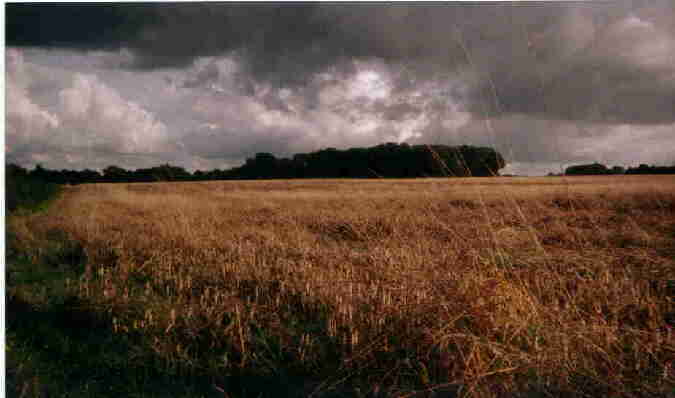
The picture, taken from the north-east corner, shows the last crop to be grown on Northfield. Unfortunately atrocious weather caused most of the harvest to be lost. The bad weather is apparent from the picture.
Northfield in Spring 2000
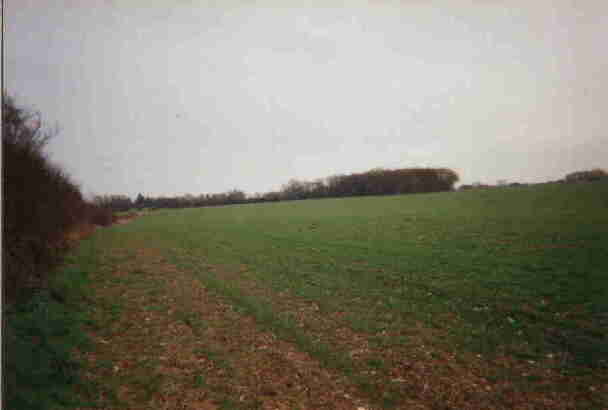
This picture is taken from the north west corner, near the Black Lion. The crop of winter wheat is visible..
1604 - Richard Overy inherits Northfield
1622 - Thomas Burrowe of Longfield buys New House Farm
1670 - Burrowe family comes to live at New House Farm
1729 - Death of James Burowe. Farm inherited by daughter Elizabeth who married William Selby
1782 - New House Farm inherited by Sarah, the wife of John Tasker of Dartford
1840 - (about) Taskers succeeded by first Thomas Bradley, then the W S and A Forrest and then Miss E M Forbes.
1900 - Henry Glover, grandfather of Roy Glover of Hartley Bottom Farm, is farm bailiff here
1911 - farm valued at £2,739, let since 1906 to a Mr Thronton at £100pa.
1926 - (by) Mr George Day of North Ash Farm is the owner
Probate Inventory of James Burrowe (1695)
This is a list compiled of all his possessions.
(Summary)
- The house (containing a kitchen, brewhouse, cellars, hall, parlour, parlour chamber, hall chamber, chamber over the kitchen, and a chamber over the brew-house)
- Barn (with wheat, barley and peas worth £33 inside)
- Wheat in field (£17)
- 3 milk cows
- 3 dairy bullocks
- 1 horse
- 5 sheep
- 4 hogs
- 32 silver spoons
- silver bowl
- 5 silver cups
- looking glass
The first paragraph of the schedule to the lease makes it clear the council should act on what the community wants. The Friends of Hartley Countryside Village Survey received almost a thousand replies (45% response). This is what you voted for and against:
4 Open Space (98% in favour)
4 Nature Conservation (96% in favour)
4 Farming (88% in favour)
4Bird Watching (80% in favour)
4 Children's Playground (51% in favour)
6 Jogging track (53% against)
6 Horse Riding (57% against)
6 Football Pitches (80% against)
6 Golf course (90% against)
The three things most wanted (by far) were Open Space, Nature Conservation and Farming. The three that got the thumbs down were Motorbikes, Rugby and Football.
For full details click here.