|
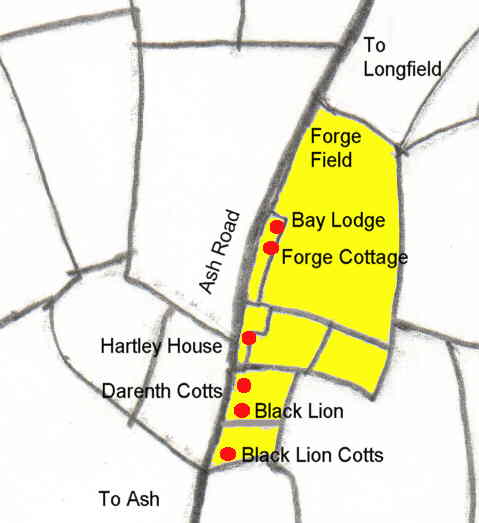
Map showing location of
properties.
|
This name, which is probably
related to woodland clearance, is just about lost today.
It was the name given to the hamlet around the
Black Lion, which in the last century formed the commercial
heart of Hartley. Because the ownership of all
the properties is so interlinked, I have dealt with
them all here. The earliest definite reference
to the land comes in 1604
when the Overy family of Fairby were the owners. Forge
Cottage and its 12 acres was the only property then,
occupied by John Warren. Adjoining that towards
Ash was a "small green", and then came the
land now commonly but erroneously called Northfield
(after all it is Hartley's most southerly field!). By
the 1640s we can see the origins of the Black Lion holding,
comprising the green and 3 acres out of Forge Cottage.
The other properties come much later.
|
|
|
|
|
|
|
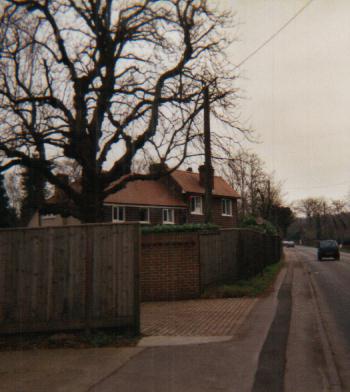
Forge Cottage
|
Black Lion
|
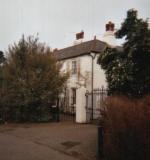
Hartley House
|
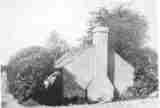
"Defoe's Cottage"
1931
|
Forge Cottage
Now
almost hidden behind a high fence, there was a smith's forge here
for at least 300 years. Thomas Edwards of Malling bought it
for £100 from the Overys in 1646.
It proved to be an excellent investment, for twelve years
later he sold it to Thomas Young of Fairby for more than twice the
price! The will of his son John (1704)
mentions the tenant Francis Treadwell, whose family were to be smiths
there for more than another century. Francis
Treadwell (1738-1819) was also
parish clerk for over 40 years - a remarkable achievement. During
the c18th the Glover family were the freehold owners of the forge
although the land appears to have been retained by the Youngs. William
Bensted of Hartley Court purchased the freehold in about 1815. Francis
Glover insured the property for £200 in 1780 with the Sun
Insurance Office, probably the first person in Hartley to do so.
It was described as timber and tile with the forge under one
roof. He must have thought better of it, for he let the policy
lapse the next year. In the succeeding century Elvy Cooper
was smith here for over 30 years, but the business had come to an
end before the first world war. When the Valuation Office
visited in 1911, they said it had been sold for £175 in 1906,
but at that time the interior of the 6 roomed house was "very
shaky and needs considerable repair", as did the outbuildings
housing the forge. Since then it has been in private ownership,
one notable person to live there was Frederick Jackson, one of the
earliest secretaries of Hartley Football Club.
Bay Lodge
This
is the neighbouring property north of Forge Cottage, named after
the bay hedge at the front. This cottage belongs to the early
part of the c19th. For much of that century the Dean family
of wheelwrights lived here. Thomas Dean the son of William
is said to have rebuilt the house and planted the hedge. Mr
P W Goldie bought it in 1906 for £450. It was described
around that time as being an old stucco and slate double fronted
house with a brick floor on the ground in fair condition. A
William Nash lived here in the 1920s, he had been coachman to Lord
Lauderdale, the Archbishop of York and Lady Dunraven.
Black Lion
In
the c17th this was a 6 acre smallholding owned by the Best family
of Middle Farm. In 1698 a cottage in the occupation of Richard
Day was said to be "lately built" there, and this would
fit in with the date range for the building given by Dr Cramp (Hart
- March 1999). Richard Glover (1680-1748),
direct ancestor of the current Glover farming family, purchased
it in 1731,
and is almost certainly the first licensed victualler here. He
with his father William were already publicans - they had leased
a pub called the Black Lion in Fawkham in 1707, and he seems to
have taken the name with him to Hartley. He and his son Francis
were sufficiently well off to be entitled to vote at a time when
the number of voters in Hartley could be counted on one hand. One
interesting aside is that at this time there was no secret ballot,
people's votes were noted down and published in "Poll Books"
- some are in Gravesend library, so you can find out how Francis
voted all those years ago. Francis sold the pub to Robert
Monk in the 1790s who sold it on to Hussey Fleet from the Dartford
brewing family. The freehold eventually came to the Dartford
Brewery, which was closed down and demolished in the 1930s when
it was taken over by Courage. Many of the licencees of the
pub have stayed for a long time and must have pulled many pints
over the years - George Wansbury (1881-1907), Charles English (1927-36)
- he drove a horse and grocery van, and was named "the midnight
grocer" because of the time of some of his deliveries!, Edward
Kitto (1941-54), Ronald and Thelma Antwiss (1964-74), and Joe and
Pam Smith from 1974 until fairly recently. A plan of the pub
in 1914 shows the grocery shop at the southern end and a store room
at the opposite end with a sitting room, tap room, private bar,
scullery and kitchen in between. Recently the building has
been extended with the addition of "Defoe's Restaurant",
the new buidling has been well executed in sympathy with the original.
Darenth Cottages
These
were approximately where the Black Lion car park is today. These
were built in wood and thatch and were the parish poorhouses since
at least the mid
c18th. After the Poor
Law Amendment Act of 1834, local paupers would have been sent to
the Dartford Union Workhouse at West Hill, so eventually the parish
sold the cottages. They were burnt down on the night of 12/13
May 1877. Arson was suspected, and William
Longhurst was accused. He
lived in a shed at the back of the cottages and had a record for
poaching. However he was sensationally acquitted at the Kent
Assizes, when it was discovered that the chief prosecution witness
had once been charged with arson of a barn. They were rebuilt
in brick, stucco and tile, and named after the home of Mr Fleet
(Darenth Grange). Two families lived here a very long time
- the Days and the Chearys. They were demolished about 1970.
"Defoe's Cottage"
Said
to have once been the home of the author, this tiny brick cottage
was between Darenth Cottages and the Black Lion. Attractive
though this legend is, it is almost certainly untrue, for there
is contemporary testimony from Francis Treadwell that it was built
by the parish in 1832
and that the first tenant was Fanny Longhurst. Local historian
Sir Stephen Tallents wrote to the Dartford Chronicle in 1937 to
point out that such evidence as there is related to the other Hartley
in Kent. It appears that this cottage was uninhabited for
a long time before it was pulled down. A picture of it appears
in the Parish Magazine of June 1931.
Black Lion Cottages
By
1800 there was a house here, which was replaced by a row of labourer's
cottages in brick and slate by 1841, said to be by the owner Mr
Cooper. It was in one of these cottages that Hartley's first
school was kept by the Misses Prowse of Hartley House. Mr
E Treadwell bought them for £360 in 1904, then their tenants
paid 3s 6d weekly, less than the 5s paid by the tenants of Darenth
Cottages, because of their poorer condition. Richard Woodward,
one of the names on the war memorial, lived at number 4. He
joined the Grenadier Guards in 1914, and served in France until
January 1916 when he contracted pleurosy, a disease which led to
his discharge and death in 1918. His is the one war grave
in the Churchyard. The cottages were replaced by the houses
Hedgeway and Pinleigh in 1973.
Hartley House
For
its age this grade II listed house is quite unique in Hartley, being
the sole example of an early c19th gentleman's residence. The
more classically influenced style is quite striking in comparison
with the local vernacular architecture. The English Heritage
lister gives an early c19th date, and indeed it first appears in
the rating lists in 1818 when a John Stokes lived here, but a map
of 1790 suggests there was already a building here. A retired
naval officer called Richard Prowse lived here 1821-32; his unmarried
daughters ran a school at the Black Lion Cottages. Many other
distinguished personages have lived here, Elizabeth Bensted, the
widow of William Bensted of Hartley Court, came here in 1836, followed
by her widowed daughter Mary Ann Parsons (1776-1864), under the provisions of
her father's will. As well as the house he left her £2,000
in stocks and shares, but made provisions to prevent her husband
Owen (the tenant of New House Farm) getting the money! She
was followed by her nephew Henry, and in 1881 Philip Binks a watchmaker
lived here. Charles Bradley the licensee of the Black Lion
lived there at the time of the next census in 1891. It was
sold in 1903 for £1,900, rather less than what it was recently
marketed for! The valuation office description in 1911 shows
3 reception rooms, a kitchen and a scullery on the ground floor;
with 6 bedrooms, toilet and bathroom above. Other buildings
included sheds, wash house and a billiard room. Three acres
of land has always gone with the house, a mixture of orchard and
pleasure grounds. The house has been recently sold, after
being in the possession of the Green family for over 25 years.
Some previous sale values:
1875 £1,050
1903 £1,900
1999
£450,000
2002 £875,000
Peter
Mayer
|